If you wish to follow along in Google Earth, here is the
kmz file for download.
April 2nd, 2010
One Sunday back in April, I was observing some action at Alyth at my usual location. I was only there for about an hour, but did manage to see the hump backing in, one train arriving from Edmonton, two trains leaving Calgary heading west, and a few locos hanging around.
I arrived at around 16:30 and as I was arriving, the Hump in the process of pushing a train over the hump into the classification tracks. Someday I would like to be able to see a hump operation in action, but I know that my chances are very slim. The lead on the hump was 6612 with 5795 both SD40-2's. An interesting bit of info is that 6612 use to be a former SOO locomotive.
As the hump was pushing in, a train lead by 9635 started pulling out heading west. There were a few auto racks at the front and the remainder of the train was intermodal. About halfway through was 9540 and that was all for locomotives on this train. It wasn't an overly long train which would explain only two locos. I would assume that the train would probably pickup another locomotive or two somewhere along the way before they reached the spirals at Field in British Columbia. Both locomotive were AC4400's.
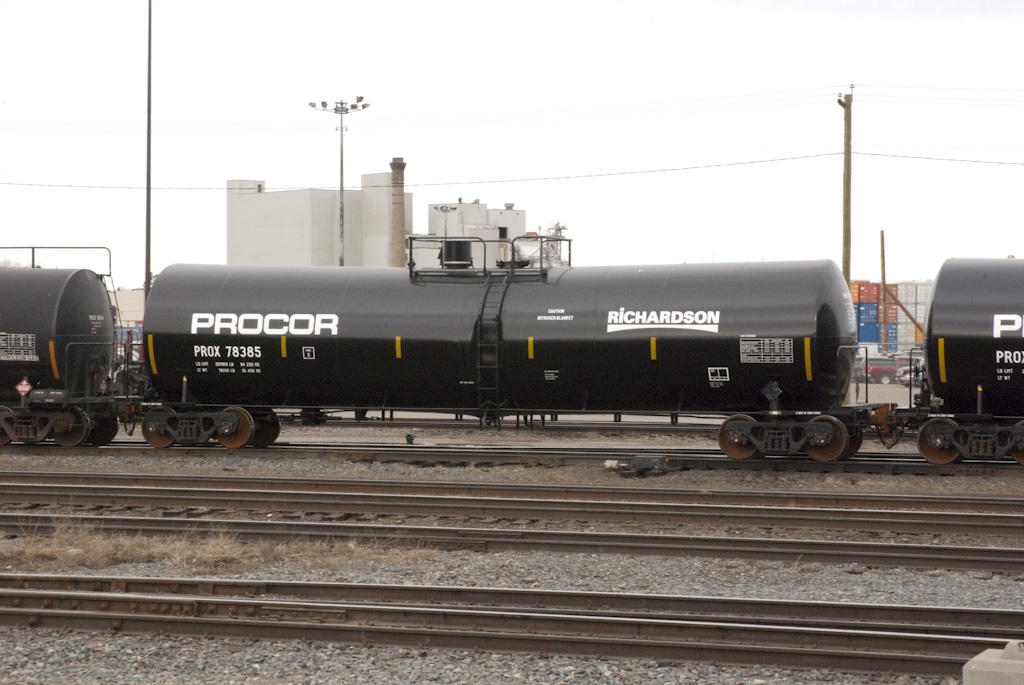
After it had gone by, I spotted a familiar paint scheme. Over by the diesel shops were FP9A's 4107 & 4106 and F9B 1900. 4106 & 4107 are the main power for the Royal Canadian Pacific passenger train. Also by the shops were CEFX 1050, CP 9753 and CP 8275, two AC4400's and a GP9. And further into the yard you could see the hump still working and another set of SD40's waiting, but they never came out while I was around and was not able to identify road numbers. Notice the blue sign indicating that track P$ if closed as there are people either inspecting or working on some of those tankers, or some other reason.
From out nowhere a team of locomotives, 8646 and 8837, in reverse were on the track heading into the wye and more than likely to turn around to latch up to a westbound train. Here is an opportunity to identify the differences between an AC4400 and an ES44AC locomotive as the two look very similar. If you look at the second picture, there are two major differences between the two locomotives. The first is the trucks and the second is the radiator hood. You can also notice the rear headlight is a single on 8646 and double on 8837, but this may not be for all railroads as some have their own preferences for headlights. There may be a few other subtle differences, but the trucks and the radiator are the two visibly major ones.
Sitting there all alone on one of the far tracks was an Alberta grain hopper number ALPX 628373 with the "Take an Alberta Break...visit Medicine Hat" slogan. It must have been a bad order or something. You can find a fairly extensive list of all the Alberta grain hopper at
Barraclou.com
About ten minutes later, a container train came in off of the wye from the north. A couple AC4400's, CEFX 1047 and CP 8604, were in the lead of this one.
I took several shots of some of the containers as well for modeling references.
After quite a few well cars there were a few box cars and hoppers and a block tankers of which I also photographed for modeling references.
As the train was going by, 8646 and 8837 showed up reversing to somewhere in the yard out of sight.
About another ten minutes later, another train was leaving the yard heading west with 8834 and 8606 pulling, and 8524 at some point in the middle. This train was all intermodal. As the train was pulling out, a couple other railfans showed and we chatted for a bit.
On one of the maintenance tracks on the far side, there were 6 locomotives that had been sitting there since my arrival. They were 5793, 3110, 3084, 9779, StL&H 1625, and 1696. Their types were SD40-2, GP38-2, AC4400, GP9 and GP9. Steve Boyko from the blog
Confessions of a Train Geek saw
1625 in Winnipeg at the diesel shop there and posted a picture on his blog. He updates his blog frequently, so there is no shortage of good info to read and videos to watch.
As I chatted with the other railfans, they mentioned that there was a KCS unit around the back side of the diesel shops. They said that there were a couple clean SD70's at Sarcee Yard. I said my goodbyes and headed out to see if I could find the KCS unit.
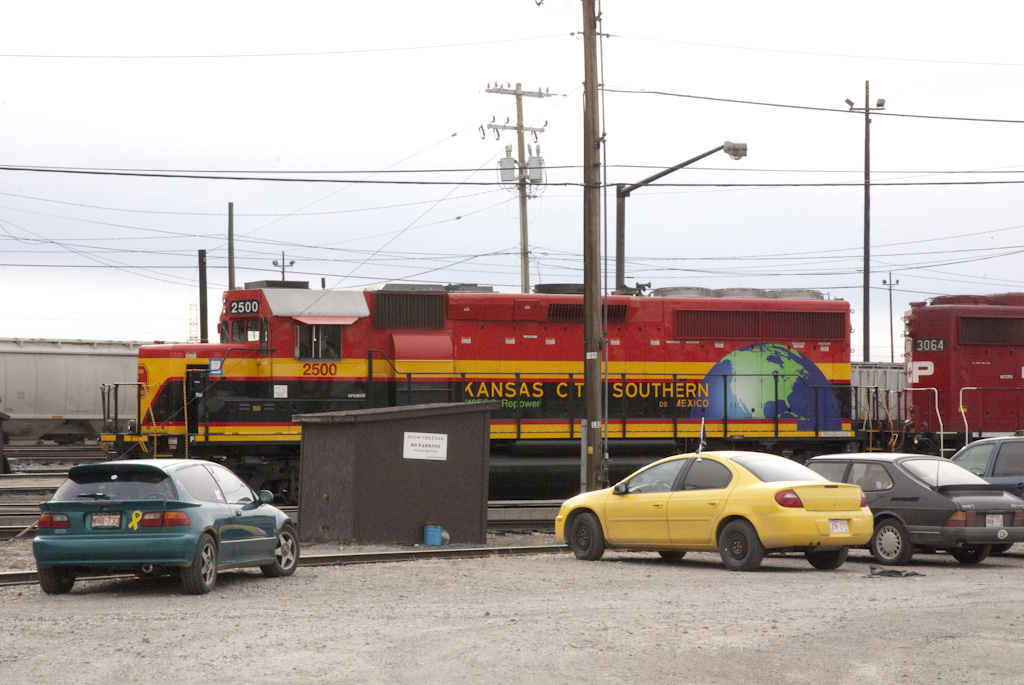
When I did find the KCS locomotive, I couldn't get a really clear view of it. The three pictures below are the best I could get. KCS 2500 is a GP40.
Apparently KCS 2500 was on loan to CP as a test unit. It and 27 other SD40's and GP40's were converted to SD22ECO Locomotives and refitted with the 710ECO diesel engine. The EMD 710 engine was used for its "record of reliability and service ability in rugged locomotive applications" as is stated in a KCS news release. You can read details on the
KCS website.
After that I headed up to CN's Sarcee Yard for
Some New CNery to spot those SD70's.
Cheers,